Showing posts with label Exploration. Show all posts

The Rediscovery of Heracleion


Heracleion, Egypt's main port before it sank into the sea in the 6th or 7th century A.D., probably due to earthquakes or floods. Located in 2000.

Magnetical Island


Just randomly read about Magnetic Island in the New Yorker. Here's a Wikipedia snippet:
The first European accounts of the island come from Captain James Cook who in 1770 while navigating the Australian coast called the island Magnetical Island as a magnetic pull interfering with his vessel's compass appeared to emanate from the island. People have since explored the general area of Magnetic Island with various instruments to discover what might have caused the effect that Cook reported, but nothing has been discovered.
And here's a World War II era observation post on the island:

Um, the Dharma Initiative called...

Oceanic Pole of Inaccessibility


I just randomly came across the Wikipedia article for Poles of inaccessibility, marking "a location that is the most challenging to reach owing to its remoteness from geographical features which could provide access." Included in its list of poles was a map of the Oceanic pole of inaccessibility, showing the area on earth farthest from any land.


I then checked out the region on Google Earth with the Wikipedia option turned on expecting to just see empty ocean floor but was surprised by a few scant entries, hundreds of miles away from anything else. They were as follows:

Bloop
The name given to an ultra-low frequency and extremely powerful underwater sound detected by the U.S. National Oceanic and Atmospheric Administration. The source of the Bloop is unknown but cryptozoologists have suggested it originates from a massive unknown sea creature. Others have ruled this out since it is several times louder than the loudest known biological sound (from the Blue Whale). [Map]

R'lyeh
A sunken city located deep under the Pacific Ocean where the godlike alien being Cthulhu is buried. [Map]

The Mysterious Island
Captain Nemo's hideout and home harbor of his ship the Nautilus. [Map]

Podesta island
A phantom island reported by the Italian Captain Pinocchio of the vessel Barone Podestà in 1879. The island was charted falsely until 1935 when it was removed from charts. The island has not been found since. [Map]

Funnily enough, Easter Island looks to be the closest civilized land to any of these places.

Strange Maps

I am the 10,000,000th person to come across the blog Strange Maps but I don't care. It is the most consistently fantastic thing I've seen online in a long, long time. It has motivated me to drag from the vaults a collection of maps I've been meaning to post on here forever. While researching a conceptual encyclopedia I made for my college senior thesis I found a wonderful old book deep in the library stacks called Unrolling the Map: The Story of Exploration by Leonard Outhwaite (1935) that I think beautifully illustrates the discovery of the world from an unashamedly Eurocentric point of view. For some reason you weren't allowed to check it out so I had to sneak a scanner into the library and covertly gather these images, coughing heavily to hide the noise. I've tried to pair them with maps detailing the same period in world history as close as I could using the book Atlas of World History by John Haywood (1997):


1800 AD — Exploration


1812 AD — Cultures


1550 AD — Exploration


1530 AD — Cultures


1490 AD — Exploration


1492 AD — Cultures


700–1300 AD — Exploration


1279 AD — Cultures


1000 AD — Exploration


1000 AD — Cultures


800 AD — Exploration


800 AD — Cultures


3000 BC — Exploration


2000 BC — Cultures

I like to imagine how mind blowing it would be to live in Europe 2000 years ago and be handed an accurate map of the world and all the people in it, or to be transported from Medieval Europe to the advanced Aztec or Mayan capitols, or Japan, or to Polynesia. It would be akin to being handed a map of the night sky with all the inhabited planets pointed out on it. Kind of like this:


New York

When I first moved to New York I would just wander around aimlessly, or as the Situationists would call it, "dérive" aka "drifting." I learned, for example, that if I got off at the 1st avenue L stop and walked in one direction I would reach a park. I also knew that if I got off at the Astor Place 6 stop and walked in another direction I would reach another park. Then suddenly, with a literal flash lighting up my mind, what had been two separate mental maps floating in the darkness fused as I realized that they were one in the same (what I later learned was called Tompkins Square Park). I would continue to try and replicate this exciting sense of discovery but as time went on I inevitably learned my way around and each discovery felt increasingly blunted, as if there was a little less magic in the world. It reminded me of an interview I read with a producer of Lost who defended the possibility that viewers may never learn what everything on the show means by citing what he called the Metachlorian effect, that the over-explanation of something (in his example the force) weakened it's power. Albert Einstein put it a little more graciously (although he probably didn't mean it to be used in this context) when he said:
The most beautiful thing we can experience is the mysterious. It is the source of all true art and all science. He to whom this emotion is a stranger, who can no longer pause to wonder and stand rapt in awe, is as good as dead: his eyes are closed.
New York's streets being forcibly reduced to a grid of numbers is the ultimate example of the death of magic. I only know this because of Speed Levitch's rant in The Cruise:


This is why I have made a point of not learning street names in Greenwich Village so that I can still get lost. While it has been pointed out to me that the grid plan was essential for generations of illiterate immigrants to navigate the city, I still wish it looked more like London's 2000 year old footpaths turned avenues: [Click for entire image]


Wouldn't you rather live in a city like that? I mean, when was the last time you ever saw an alley in the city? It's a travesty! As far as I'm concerned, the only good thing about the grid plan is Manhattanhenge (which just so happens to happen on my birthday).

PS: I was looking for a picture of one of those Family Circus cartoons showing the path of everywhere Billy had gone in a day to ironically illustrate my wandering around the city but instead I found a whole series of Family Circus cartoons mashed up with H.P. Lovecraft quotes!

Terraforming

This is from a series of space colony ideas NASA commissioned in the 70s. I wish the 70s had lasted forever...

I've been searching for this great article I read about the impracticality of every conceived form of inter-system space travel but can't for the life of me find it. I can only remember a few of the criticized scenarios off-hand. One of the ideas for traveling between planets are these things called
generation ships that would be massive ships (possibly created from a hollowed out asteroid) capable of supporting the multiple generations worth of humans needed to survive the passage. Many sci-fi writers have already pointed out that even if the life support systems of these ships didn't break down, within a few (genetically limited) generations it is likely that people would begin to forget where they came from, where they were going and what their purpose was. The cruelest/funniest idea was that should one of these generation ships (or a ship carrying people in induced comas or what have you) finally arrive at its destination it is very likely that humans would have in the meantime invented exponentially faster forms of space travel, passing these older ships in transit to settle these other planets ahead of them so that the original space travelers, instead of stumbling out onto a lifeless planet would be greeted by just another earth outpost station or even city!

So instead of finding this essay I stumbled upon these great renderings of how Mars, Venus and the Moon would look if we terraformed them:


Mars


Venus


The Moon

A Visit to the Natty Hist. Museum


Liam Lynch's (aka one half of Sifl & Olly) Museum Rap
I really hope The X-Wing dance move catches on...

When I first moved to the city I spent 1 week deciding what my dream job would be (diorama builder at the Natural History museum), 1 week drafting a letter and 2 weeks waiting for them to call and offer me a job. After a month I figured out I should probably be looking for other work at the same time. I can't believe I was that stupid. I still love dioramas though, my friend Jeremy and I had this great idea to start making shoebox dioramas to send to each other in the mail. It never happened, probably because it would have required quitting our jobs and all other extra-curricular activities in order to get them done.


This is a metal album cover waiting to (please guys) happen:


I had an epiphany that owls are pretty much
flying cats:


These types of mineral formations make me think about what an alien manufactured object would begin to look like, something completely divorced from the entire human history of creation yet recognizably designed. Actually it reminds me of the ancient alien tomb that surfaces a few hundred miles off New Zealand in HP Lovecraft's The Call of Cthulu. Some sailors come upon it and are sickened by "the geometry of the dream-place...abnormal, non-Euclidean, and loathsomely redolent of spheres and dimensions apart from ours." This feeling, and Lovecraft's general deal (as far as I've read of him), is summed up in the opening paragraph of the same story thusly:
"The most merciful thing in the world, I think, is the inability of the human mind to correlate all its contents. We live on a placid island of ignorance in the midst of black seas of infinity, and it was not meant that we should voyage far. The sciences, each straining in its own direction, have hitherto harmed us little; but some day the piecing together of disassociated knowledge will open up such terrifying vistas of reality, and our frightful position therein, that we shall either go mad from the revelation or flee from the deadly light into the peace and safety of a new dark age."
The guy is pretty much the anti-Sagan (and predictor of Reavers).


Peking


Alexandria


I forget which city this is (note the flying carpet hovering above the city). The shifting scale and perspective on these things is really impressive.

Either We're Alone in the Universe Or Not...


The Voyager Golden Record
Sounds and Images

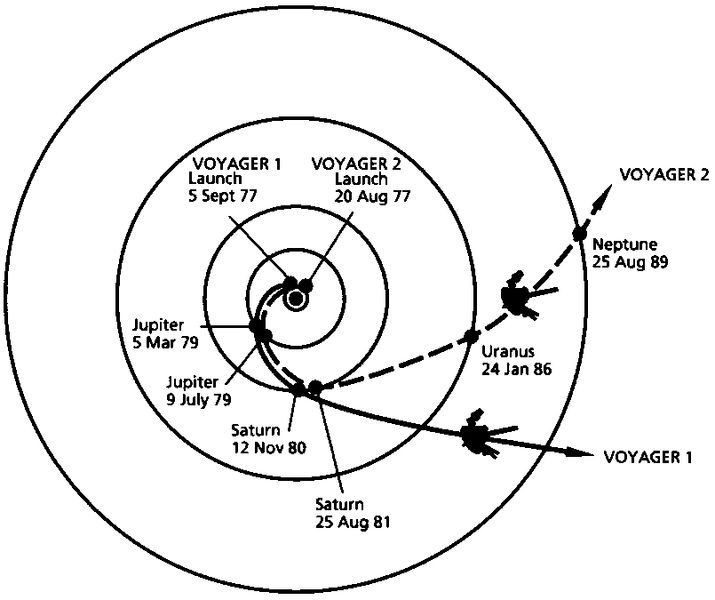
30 years ago, taking advantage of the favorable alignment of the planets in the late 70s, NASA launched two probes, Voyager 1 and 2, with the goal of studying Jupiter and Saturn. (I'd take time to talk about how amazing the Pale Blue Dot is but I would go on forever.) Once they completed studying Jupiter and Saturn (of which little had previously been known) they continued in different directions and are now on the fringes of our solar system, where the Sun's influence gives way to other galactic bodies. To give you a sense of how far that is, Voyager 2 is now twice as far from the Sun as Pluto and its signals take 14 hours to reach Earth. As of last year, the two spacecraft became the third and fourth human artifacts to escape entirely from the solar system (preceded by Pioneers 10 and 11, which were launched in 1972 and 1973).

Mindful of this mind-boggling fact, the astronomers Carl Sagan and Frank Drake somehow convinced NASA to bolt a gold-plated copper phonograph record to the outer hull of Voyager containing information chosen by a committee chaired by Sagan. This information was etched into gold and is expected to last a billion years, which, as the producer of the record points out in a very Sagan-ian way, is as far in the future as life on earth emerging from the seas was in the past.

If alien cultures or future human civilizations were to intercept the satellite (which is all but impossible, the symbolism of reaching out being the more important aspect here) and were able to figure out how to use the attached record player cartridge they would be greeted by an encoded analog signal that once calibrated would render a series of 115 images (think of a fax machine) followed by greetings in 55 languages, nature sounds, and 90 minutes of music from all over the world as well as printed messages from UN Secretary-General Kurt Waldheim and this one from President Carter:
"We cast this message into the cosmos ... Of the 200 billion stars in the Milky Way galaxy, some—perhaps many—may have inhabited planets and space faring civilizations. If one such civilization intercepts Voyager and can understand these recorded contents, here is our message: We are trying to survive our time so we may live into yours. We hope some day, having solved the problems we face, to join a community of Galactic Civilizations. This record represents our hope and our determination and our goodwill in a vast and awesome universe ... This is a present from a small, distant world, a token of our sounds, our science, our images, our music, our thoughts and our feelings. We are attempting to survive our time so we may live into yours."
(One of my favorite things about this record is that they mix in whale songs and bird calls as if they're just one more greeting in another language!)

Overlooking the burst of radio and television signals that are now forever radiating outwards from earth, the idea that these images and sounds may conceivably become the only surviving remnants of our existence makes me giddy with delight and a little choked up. Just listen to Blind Willie Johnson play Dark Was the Night and think of it hurtling through a cold empty darkness you can't even begin to imagine. If I ever cried, I would cry now.

Perhaps one of the most accurate things the project revealed about humanity (or at least Americans) was that when the public got wind that the illustration on the disc included drawings of a nude woman and man, newspapers began receiving angry letters accusing NASA of wasting taxpayer money to send "obscenities" into space. On a further bitter note (and to provide one more reason to get rid of record labels forever), Sagan and the Beatles both wanted to include the song Here Comes the Sun but the Beatles label EMI wouldn't allow it. Seriously, what the fuck? On a side note of a side note, in 2002 the British band Blur (also on EMI) composed a song to be beamed back from the surface of Mars by the Beagle 2 (a British landing spacecraft that was part of the European Space Agency's 2003 Mars Express mission) to signal its safe arrival. Sadly the craft was either lost in transit or malfunctioned on the surface and was never heard from.

So here's the game (more of the photos can be found here): As an alien (and assuming that you can process audio and visual signals in the same frequencies as humans-however unlikely), look at some of the images from the record and extrapolate the existence of the human species, and their location, ecosystem, biology, genetics, reproduction, cultures, societies, mathematics etc. from the following selection of images from those record contains. I can't stop laughing! And keep in mind, these will probably become the only surviving documents of the human race:


In case you didn't notice, one of the first photos of Earth are of Egypt, the Nile and the Red Sea, as if they'd possibly recognize it! (Or would they?)


The infection takes hold!


People become transparent as a parasite develops?


Dolphins fly.


A doctor treating a sick human?


A small human riding an enslaved larger human? Answer: Obviously, since it clearly also has four appendages and a face, therefore human.


Humans first attempt at reaching space.


Humans ambulate by becoming transparent and then tumbling forward.


Earthings eventually grew to be larger than their planet and had to leave:


Fish float in the air or (and this is more likely) there is a separate underwater race of humans...


...that can't touch solid ground and try to catch land-based humans using nets...


...Which is why the land-based humans must erect watchtowers along the waterline:

I prefer to imagine that my tax dollars are only going towards the federal government hiring actors to demonstrate licking, eating and drinking:


This is my favorite picture of the group (it reminds me of my friend Jeremy in 2057) and if they can't understand why it's great than I didn't really want to meet them anyway: