Showing posts with label Star Wars. Show all posts

The Annotated Star Wars Trilogy


I can't remember ever geeking out this hard on something. The annotated Star Wars trilogy, complete with deleted scenes, alternate takes and angles, on-set audio, bloopers, cast and crew commentary, and non-stop pop-up info. Watch them before Lucas throws a hissy fit:


He's also done one for Raiders of the Lost Ark and appears to be at work on a Jaws one.

Some of the many many factoids:
  • The noise of the Tie-Fighter is that of a slowed down elephant call, mixed with the sound of a car driving on a wet road.
  • Yoda could be etymologically derived from the Sanskrit yoddha ("warrior") and/or the Hebrew yodea ("one who knows").
  • Endor is the name of a place in the Bible, where king Saul went on the eve of his final battle and came across "The Witch of Endor." It is also the Elvish name for Middle Earth in J.R.R. Tolkein's Lord of the Rings.
  • Mark Hamill is surprisingly funny: "When I read the third one I mostly was upset with the cavalier attitude towards Boba Fett. He'd been built up as this monumental bounty hunter and he suddenly just gets, you know, he just flies away. I thought that was going to be a major revelation. Off comes the helmet: 'Oh my God, it's my mother! She's a double agent working for the good guys!'"

Related, Patton Oswalt's Star Wars filibuster:

Movie Maps

I can't stand how great these are. Andrew DeGraff's visualizations of the Indiana Jones and Star Wars trilogies:


Happy May the Fourth!


Via the fantastic image blog This Is Not Porn.

Computer Love

Has anyone else seen this? R2 and 3PO on Sesame Street:


"Firemen come along, attach their hoses to it, turn it on, and water comes out!" That's what she said! (Sorry sorry sorry)

Strange Maps

I am the 10,000,000th person to come across the blog Strange Maps but I don't care. It is the most consistently fantastic thing I've seen online in a long, long time. It has motivated me to drag from the vaults a collection of maps I've been meaning to post on here forever. While researching a conceptual encyclopedia I made for my college senior thesis I found a wonderful old book deep in the library stacks called Unrolling the Map: The Story of Exploration by Leonard Outhwaite (1935) that I think beautifully illustrates the discovery of the world from an unashamedly Eurocentric point of view. For some reason you weren't allowed to check it out so I had to sneak a scanner into the library and covertly gather these images, coughing heavily to hide the noise. I've tried to pair them with maps detailing the same period in world history as close as I could using the book Atlas of World History by John Haywood (1997):


1800 AD — Exploration


1812 AD — Cultures


1550 AD — Exploration


1530 AD — Cultures


1490 AD — Exploration


1492 AD — Cultures


700–1300 AD — Exploration


1279 AD — Cultures


1000 AD — Exploration


1000 AD — Cultures


800 AD — Exploration


800 AD — Cultures


3000 BC — Exploration


2000 BC — Cultures

I like to imagine how mind blowing it would be to live in Europe 2000 years ago and be handed an accurate map of the world and all the people in it, or to be transported from Medieval Europe to the advanced Aztec or Mayan capitols, or Japan, or to Polynesia. It would be akin to being handed a map of the night sky with all the inhabited planets pointed out on it. Kind of like this:


Catalog of Monsters

In 2005 I went to the Little Boy exhibition at the Japan Society which featured images from the book An Anatomical Guide to Monsters (1967) that I desperately scoured the internet for but couldn't find. Thankfully someone finally posted some more images from either it or a book doing exactly the same thing and has allowed me to tag this post with all my favorite labels:

On a related note, these are also cool:

Starships


Now this is impressive. This guy has created a size comparison chart of every major space station and starship in science fiction (sadly in 2003 so the new Battlestar Galactica ships aren't included). If you look closely he has also included the real space shuttle and a Yamato Class battleship (a Japanese WWII era boat that remains the largest battleship ever built to this day). Look how tiny the Enterprise is!

My Favorite Moons

This post got a little out of hand. I don’t think I’ll ever write about moons again.

I have to start somewhere so let’s just begin with the formation of the solar system (note: just because the narrator has an English accent doesn’t mean one should forgive the explosion sound effects they added to the video):


Thus we end up with a moonless proto-Earth until roughly 4.5 billion years ago when it is theorized it suffered the biggest blow our planet has ever experienced. Recent chemical research has shown that the Mars-sized planet that Earth collided with was its twin, a planet called Theia (mother of the Moon in Greek mythology) that must have formed in an orbit almost identical to that of the Earth's. The collision was a glancing one, it shattered our Earth, but pulverized the incoming planet. Simulations show the impactor being sprayed out into a shower of orbiting debris. But within a matter of hours, much of this had re-grouped to form a new impactor that smashed into the Earth's surface a second time at which point the impacting object was destroyed. Most of the impactor rained down on to, and became incorporated into, the Earth - the last major component to be integrated into our planet. Scientists call this point “time zero” as anything that had happened to the Earth geologically before would have been erased. The remaining 10% or so of the impactor’s mass was spread out into an incandescent disc around the Earth - a scorching equivalent of Saturn's rings. It was out of this material that the Moon was formed in a matter of decades.


(This is the best animation I could find. It’s from the beginning of the BBC’s Walking With Monsters series so the second half of the clip isn’t exactly pertinent but is definitely awesome)

At this time the moon was 15 times closer than than it is today. If you had been able to stand on the surface of the Earth (although its surface was probably melted down to a depth of 1,000 kilometers, cloaking the Earth in a magma ocean) you would have seen a moon that appeared 15 times larger than it does today.


Fortunately the Moon-forming impact gave the Earth the spin on its axis that now gives us 24-hour days and stirs up the atmosphere so that no part of the Earth is too hot or too cold for life, so don’t knock it.

Google now let’s you peruse the Moon in a Google Maps style format. They also recently offered a 25 million dollar “Lunar X Prize” calling for entrants to land a rover on the moon that will be able to travel at least 500 meters and send high-resolution video, still images and other data back home. Last month NASA announced plans to construct a permanent base on the moon by 2020, a move some consider an essential step towards humankind’s ultimate survival.

Lastly, who can forget the best Onion headline ever.

[1] [2]

---------------------------------------------------------
-------------------------------


Lapetus of Saturn

Saturn’s moon Lapetus has been dubbed “The Walnut Moon” because of a unique ridge that runs 1300 km along its equator, 20 km wide and 13 km high. It was discovered when the Cassini spacecraft imaged Lapetus on December 31, 2004. Parts of the ridge rise more than 20 km above the surrounding plains. The ridge forms a complex system including isolated peaks, segments of more than 200 km and sections with three near parallel ridges. Within the bright Roncevaux Terra there is no ridge, but there are a series of isolated 10 km high peaks along the equator. The ridge system is heavily cratered, indicating that it is ancient. Unsurprisingly plenty of people rushed to declare it an ancient barricade or marker created by an alien civilization but in truth it appears to have been formed after the crust froze, when the interior of the planet contracted for some reason, squeezing the crust as though in a vice.


[3] [4]

----------------------------------------------------------------------------------------


Europa of Jupiter


My favorite moon by far (so far).

It is thought that below the permanently frozen surface of Europa there lies a global subsurface layer of liquid or slushy water kept warm by tidally generated heat. The most dramatic example in support of this theory is "chaos terrain," a common feature on Europa's surface that some interpret as a region where the subsurface ocean melted through the icy crust. This interpretation is extremely controversial. Most geologists who have studied Europa favor what is commonly called the "thick ice" model, in which the ocean has rarely, if ever, directly interacted with the surface. The different models for the estimation of the ice shell thickness give values between a few hundred meters and tens of kilometers.

The best evidence for the so called "thick ice" model is a study of Europa's large craters. The largest craters are surrounded by concentric rings and appear to be filled with relatively flat, fresh ice; based on this and on the calculated amount of heat generated by Europan tides, it is predicted that the outer crust of solid ice is approximately 10–30 km thick, including a ductile "warm ice" layer, which could mean that the liquid ocean underneath may be about 100 km deep, suggesting that Europa's oceans are slightly more than twice the volume of Earth's.


The so called "thin ice" model is a conclusion of the formation of ridges and the flexure of the ice shell due to loading at the surface. With these models the crust of solid ice could be as thin as 200 meters. The "thin ice" model allows regular contact of the liquid interior with the surface through open ridges.

The Galileo orbiter has also found that Europa has a weak magnetic field which varies periodically as Europa passes through Jupiter's massive magnetic field. A likely explanation of this is that there is a large, subsurface ocean of liquid salt water.

This moon intrigues astrobiologists because of its potential for having a “habitable zone.” Life may exist in this ocean, perhaps subsisting in an environment similar to Earth's deep-ocean hydrothermal vents or the Antarctic Lake Vostok (another very interesting subject!).

So far there is no evidence that life exists on Europa but due to the likely presence of liquid water, there are proposals to send a probe there. One proposal calls for a large nuclear powered "Melt Probe" (cryobot) which would melt through the ice until it hit the ocean below. Once it reached the water, it would deploy an autonomous underwater vehicle (hydrobot), which would gather information and send it back to Earth. Both the cryobot and the hydrobot would have to undergo some form of extreme sterilization to prevent it from detecting earth organisms instead of native life and to prevent contamination of the subsurface ocean.


Personally I am very excited about this hopefully happening in my lifetime. For years I’ve dreamt of us discovering some sort of highly intelligent space whales there but am prepared to be disappointed. (Not to be confused with the Acanti)


A "Solar System Exploration Roadmap" published for NASA in 2006 placed exploration of Europa high on its list, and suggested that plans for a "flagship-class" mission to Europa begin by 2008 with hopes to launch by 2015.

[5] [6]

----------------------------------------------------------------------------------------

Io of Jupiter


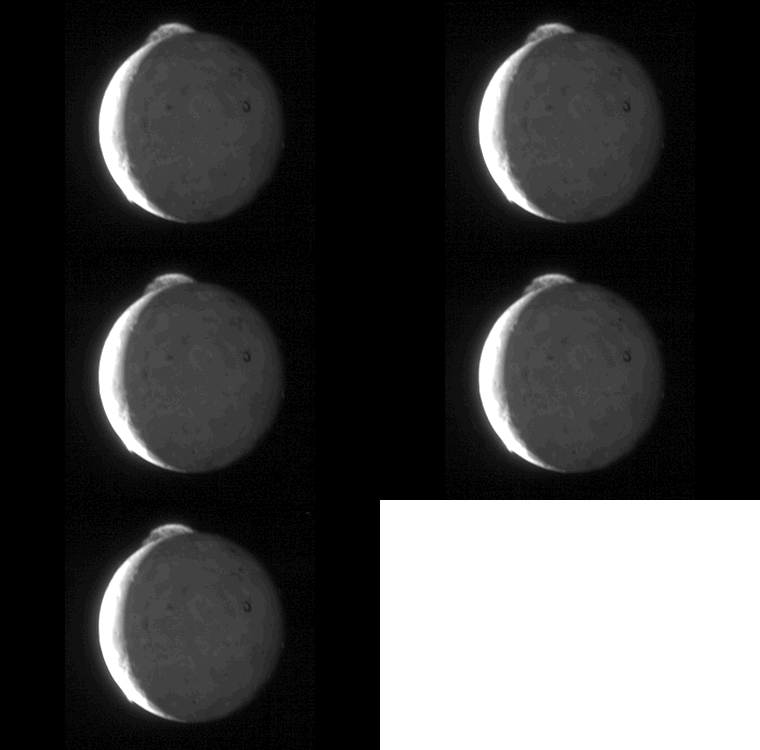
Io is the most volcanically active body in the solar system. As it travels, Jupiter's immense gravity causes “tides” in the solid surface 100 meters high, generating enough heat to give rise to the volcanic activity and drive off any water. Io's volcanoes are driven by hot silicate magma.

(I found a great clip of Io erupting that won't show up on this page for some reason so just click here to see it)

[7]

----------------------------------------------------------------------------------------


Minmas
of Saturn


“That’s No Moon”

On a side note, several people are pointing out the catastrophic result of detonating a 500 mile wide object in low orbit above a small moon. This theory is generally referred to as The Endor Holocaust. Of course there are also deniers.

----------------------------------------------------------------------------------------

Moons with Moons


Although scientists haven’t identified any yet it is theoretically possible (and therefore highly likely) for moons to have sub-satellites of their own! It depends on the object’s gravitational sphere of influence called its Hill or Roche sphere. Earth, for example, has a Hill sphere of 1.5 million km. The Moon's orbit, at a distance of 0.384 million km from Earth, is comfortably within the gravitational sphere of influence of Earth and it is therefore not at risk of being pulled into an independent orbit around the Sun. The Moon has its own Hill sphere with a radius of 60,000 km (1/6th of the distance between the Earth and Moon) where a sub-satellite could exist. If an object lies outside the Moon's Hill sphere, it will orbit Earth instead of the Moon. The only problem is that the sub-satellite cannot stay in orbit around the Moon indefinitely because of tides.

[8] [9]

----------------------------------------------------------------------------------------
Uranus + Shakespeare

“O, swear not by the moon...”

While most of the satellites orbiting other planets take their names from Greek mythology, 25 of Uranus' 27 moons are unique for being named after characters from Shakespeare (including Puck!):

A Midsummer Night's Dream: Titania, Oberon, Puck
The Tempest: Ariel, Miranda*, Caliban, Sycorax, Prospero, Setebos, Stephano, Trinculo, Francisco, Ferdinand
King Lear: Cordelia
Hamlet: Ophelia
The Taming of the Shrew: Bianca
Troilus & Cressida: Cressida
Othello: Desdemona
Romeo and Juliet: Juliet, Mab
The Merchant of Venice: Portia
As You Like It: Rosalind
Much Ado About Nothing: Margaret
The Winter's Tale: Perdita
Timon of Athens: Cupid

* In the fictional Star Trek universe, the crystalline mineral dilithium was first discovered on Miranda in the mid-21st century. The moon said to be the only naturally occurring source of dilithium in the Sol system. This mineral was, a short time later, used to facilitate warp drive propulsion systems which allowed spacecraft to achieve faster-than-light travel.**

** Despite this being the second Star Trek reference in this blog I need to say that I'm really not that big a Star Trek fan, although I do deeply, deeply respect it.

[10] [11] [12]

----------------------------------------------------------------------------------------

Earth’s “Second Moon”


Earth has a “second moon,” the asteroid 3753 Cruithne that I’m too lazy and tired to explain.

[13] [14]

----------------------------------------------------------------------------------------

As much fun as it is to be reminded of how mind-boggling the universe is it can also leave you feeling cold, alone, and insignificant. On the other hand, most of space is empty and what little remains is cold, boring rock and dust. It's important to remember how fascinating it is to be human, especially a human in 2007 with a high-speed internet connection so you can watch scenes from the fantastic 1974 film adaptation of The Little Prince co-starring Gene Wilder and Bob Fosse!


If my kids don't sound exactly like the Little Prince I'm disowning them. As far as I'm concerned all children should speak with British accents, have perfectly messy hair and smell of peanut butter. Oh, and while we're at it, check out how much Michael Jackson completely ripped-off Bob Fosse in this clip!